

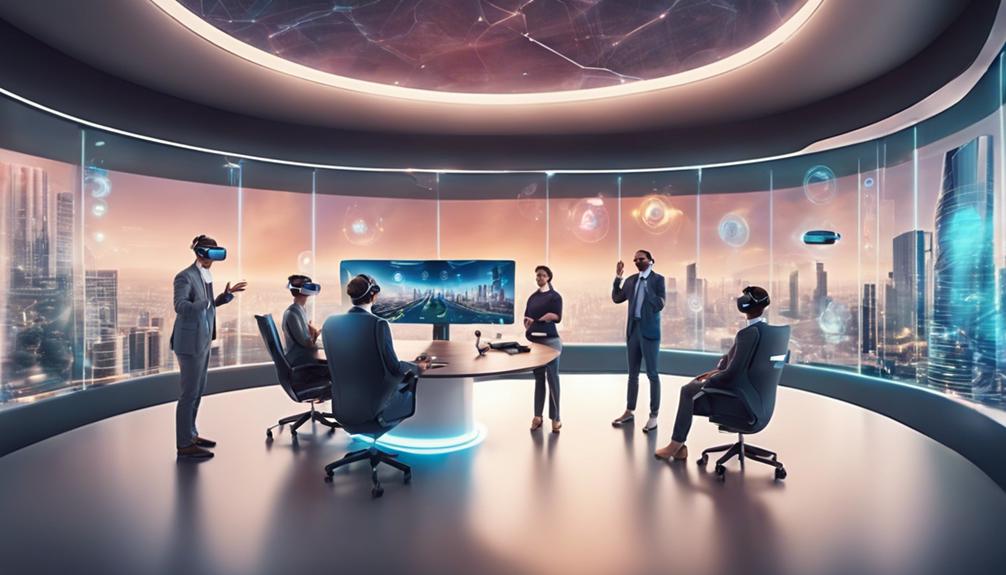
We're now witnessing a significant shift in business training programs, where virtual reality is rapidly becoming an essential tool for enhancing employee skills and knowledge. Immersive learning boosts retention rates by up to 80% and simulates real-world scenarios for practice. In soft skills training, VR enables role-playing and empathy-building experiences. Industry applications are vast, from healthcare to retail. While adopting VR training comes with challenges, the benefits far outweigh the costs. As VR continues to revolutionize business training, we're just scratching the surface of what's possible – and it's exciting to think about what's yet to come.
The Benefits of Immersive Learning
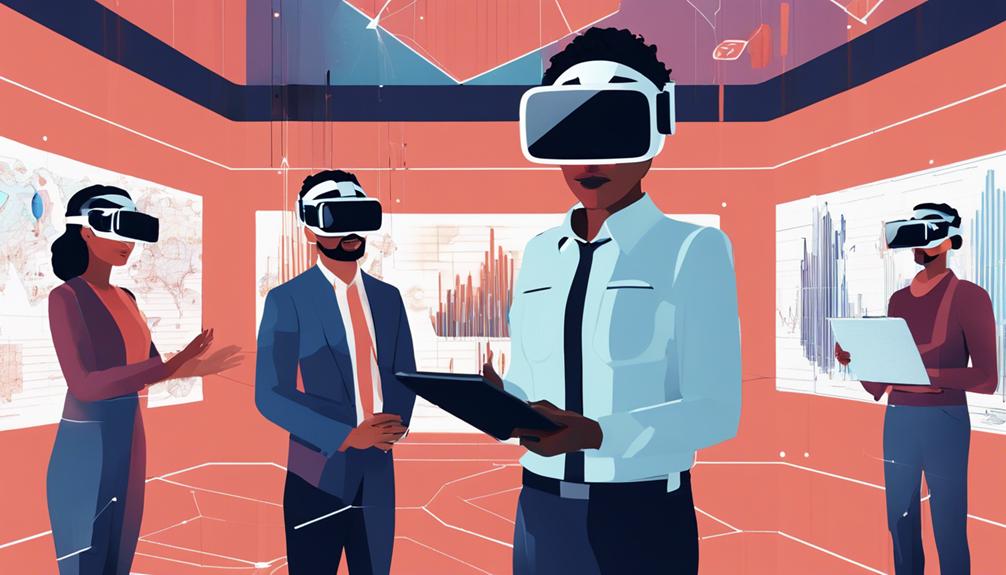
By leveraging immersive learning experiences, we can increase knowledge retention rates by up to 80%, making virtual reality a highly effective tool for business training programs. This is because immersive experiences engage our senses, making information more memorable and easier to recall. We've all experienced the struggle of trying to recall a complex concept or procedure after a traditional lecture-style training session. With virtual reality, we can simulate real-world scenarios, allowing us to practice and apply what we've learned in a safe and controlled environment.
We're not just talking about memorization, either. Immersive learning experiences have been shown to increase confidence and competence in applying new skills. When we're fully immersed in a virtual environment, we're more likely to take risks and try new things, which is essential for skill-building and development. Plus, because virtual reality experiences can be repeated and refined, we can focus on specific areas where we need improvement.
The benefits of immersive learning extend beyond just knowledge retention and skill-building, too. By reducing anxiety and stress, virtual reality experiences can help us feel more comfortable and confident in our abilities. This, in turn, can lead to improved job performance and better decision-making. As we continue to explore the potential of virtual reality in business training programs, it's clear that immersive learning experiences will play a key role in shaping the future of employee development.
VR in Soft Skills Training
How can we effectively develop essential soft skills like communication, empathy, and conflict resolution in a rapidly changing workplace? Traditional training methods often fall short in providing employees with the skills they need to thrive in today’s fast-paced business environment. That’s where virtual reality (VR) comes in. We’re excited to explore the potential of VR in soft skills training. By immersing employees in realistic scenarios, VR can create a safe space for practicing essential interpersonal skills without the fear of real-world consequences. This innovative approach not only enhances engagement but also allows participants to navigate complex social interactions, equipping them with the tools needed to handle mental health challenges at work. As employees become more adept at understanding and empathizing with others, they can foster a more supportive and collaborative workplace culture.
By leveraging VR, we can create immersive and interactive experiences that simulate real-world scenarios, allowing employees to practice and develop their soft skills in a safe and controlled environment. Here are just a few ways VR is revolutionizing soft skills training:
- Role-playing made easy: VR enables employees to practice difficult conversations, conflict resolution, and other soft skills in a realistic and engaging way.
- Empathy building: VR experiences can be designed to put employees in others' shoes, fostering empathy and understanding in a way that traditional training methods can't.
- Realistic scenarios: VR can simulate real-world scenarios, allowing employees to practice their soft skills in a realistic and engaging way.
- Data-driven feedback: VR training programs can provide detailed feedback on an employee's performance, helping them identify areas for improvement.
- Cost-effective: VR training programs can reduce costs associated with traditional training methods, such as travel and facilitator fees.
Industry Applications of VR Training
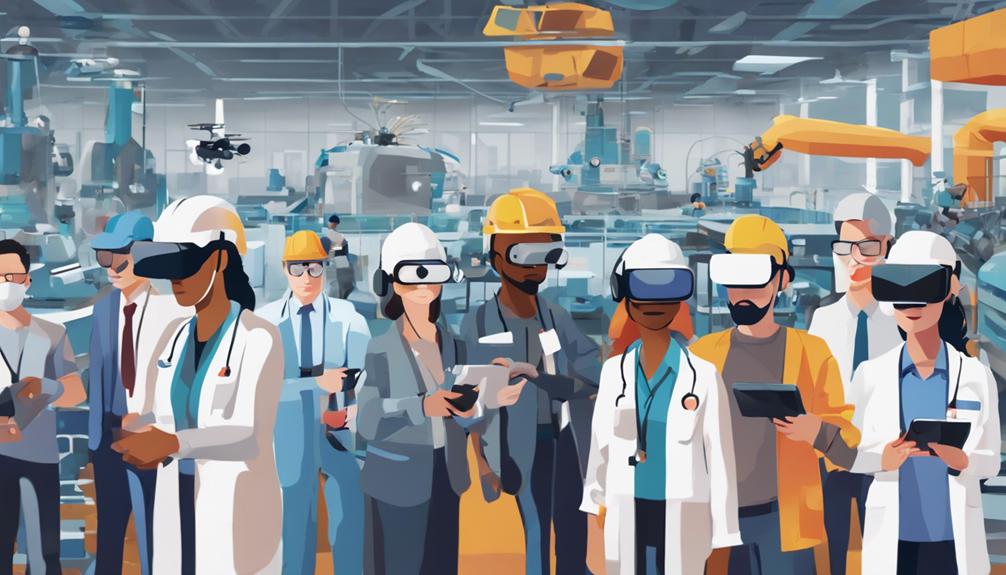
We've seen the impact of VR in soft skills training, but now we're excited to explore its applications across various industries, where tailored VR training programs can address specific pain points and improve overall performance. In the healthcare industry, for instance, VR can simulate surgeries, patient interactions, and emergency response scenarios, allowing medical professionals to practice and refine their skills in a realistic yet risk-free environment. In manufacturing, VR can enhance production line efficiency by training workers on complex machinery operations, improving quality control, and reducing errors.
In the aviation industry, VR-based simulation training can prepare pilots for emergency situations, reducing the risk of accidents and improving overall safety standards. Similarly, in the oil and gas sector, VR can simulate hazardous environments, enabling workers to practice emergency response and crisis management in a controlled setting. We're also seeing VR being used in the retail industry to train sales associates on product knowledge, customer service, and point-of-sale operations. By leveraging VR training, businesses can create immersive, interactive, and engaging experiences that cater to their unique industry needs, ultimately leading to improved performance, increased productivity, and enhanced customer satisfaction.
Overcoming Challenges of Adoption
Implementing VR training programs can be a challenging task, especially when faced with the inevitable challenges of adoption, from overcoming employees' initial skepticism to ensuring seamless integration with existing infrastructure. As we navigate these obstacles, we've found that it's essential to address the concerns of our team members and stakeholders.
To overcome these obstacles, we've developed strategies to guarantee a smooth shift. Here are a few key takeaways:
- Develop a clear communication plan: Educate employees on the benefits and goals of VR training to alleviate skepticism and build buy-in.
- Conduct a thorough infrastructure assessment: Verify that our existing technology can support VR integration, and make necessary upgrades to avoid compatibility issues.
- Provide detailed training for administrators: Equip our team with the skills and knowledge needed to effectively implement and manage VR training programs.
- Start small and scale up: Pilot VR training with a small group to work out kinks and refine our approach before expanding to larger teams.
- Continuously monitor and evaluate: Regularly assess the effectiveness of our VR training programs and make adjustments as needed to optimize results.
The Future of VR in Business

As we've successfully navigated the challenges of adopting VR training programs, we're now poised to capitalize on the vast potential of this technology to revolutionize the future of business operations. We're no longer just experimenting with VR; we're harnessing its power to drive real results. In the near future, we expect to see VR become an integral part of our daily business operations.
We envision a future where VR-enabled training programs are the norm, allowing employees to develop skills in immersive, interactive environments. We predict that VR will enable us to simulate complex scenarios, analyze data in 3D, and collaborate with remote teams more effectively. With VR, we'll be able to create bespoke training programs tailored to individual needs, reducing costs and increasing efficiency.
As VR technology advances, we expect to see the boundaries between physical and virtual spaces blur. We'll be able to teleport ourselves into virtual meetings, conduct virtual site visits, and even create virtual supply chains. The possibilities are endless, and we're excited to explore them. By embracing VR, we're not just future-proofing our businesses – we're creating a new reality. One where training is more engaging, collaboration is more seamless, and innovation knows no bounds. The future of VR in business is bright, and we're thrilled to be at the forefront of this revolution.
Frequently Asked Questions
Can VR Training Be Used for Compliance and Regulatory Training?
We're on the same page when it comes to compliance and regulatory training – it's a necessary evil. Can VR training be used for this type of training? Absolutely! In fact, it's a no-brainer. By simulating real-world scenarios, VR training allows us to practice and perfect our compliance skills in a low-stakes environment. It's a win-win, as we can confirm we're up to code without risking real-world consequences.
How Do I Measure the ROI of VR Training Programs?
'We're excited to measure the ROI of our VR training programs, and we're not alone. To start, we identify specific goals and KPIs, like reduced errors or increased productivity. Next, we track learner engagement, assessment scores, and time-to-competency. We also survey learners and managers to gauge satisfaction and perceived value. By comparing these metrics to our investment, we can calculate a clear ROI and make data-driven decisions about future VR training initiatives.'
Can VR Be Used for Leadership Development and Executive Training?
We're thrilled to explore how VR can elevate leadership development and executive training. The immersive nature of VR allows for realistic, risk-free simulations that mimic real-world challenges, perfect for honing leadership skills. We're seeing VR being used to train executives in areas like crisis management, communication, and decision-making. It's an innovative way to develop the next generation of leaders, and we're excited to see its impact.
Are VR Headsets a Hygiene and Cleanliness Concern?
We can't help but wonder, as we slip on a VR headset, have we sanitized it since the last user? The thought sends a shiver down our spines. In reality, most of us don't think twice about sharing VR gear, but we should. With VR headsets, hygiene and cleanliness are significant concerns. Germs and bacteria can spread easily, putting users at risk of infection. It's essential we prioritize sanitation to guarantee a healthy VR experience.
Can VR Training Be Used for Onboarding New Employees?
We're excited to explore the possibility of using VR training for onboarding new employees. It makes sense to utilize this technology to streamline the process. We can create immersive, interactive experiences that simulate real-world scenarios, allowing new hires to get familiar with company protocols and procedures in a controlled environment. This could reduce anxiety and increase confidence, making the onboarding process more efficient and effective.
