

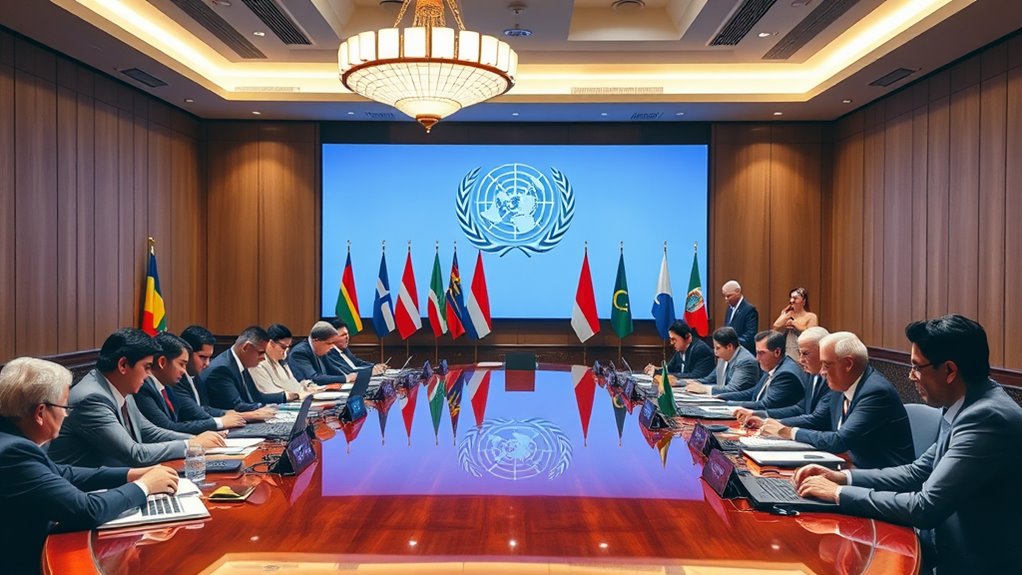
International organizations play an essential role in global politics by facilitating cooperation among states. They address transnational challenges, promote sustainable development, and help maintain peace and security. Through diplomatic negotiations, these organizations develop policies that respond to crises as they provide humanitarian aid and conflict resolution mechanisms. In spite of facing challenges like funding issues and political interference, their impact remains significant in managing shared global concerns. Discovering more about their evolving functions can provide deeper insights into their influence.
Historical Evolution of International Organizations
Though international organizations have existed in various forms for centuries, their modern structure and function began to take shape in the aftermath of World War I. The historical context of this period was marked by a desire for stability and cooperation among nations following the devastating conflict. The League of Nations emerged as one of the first attempts to create an organizational framework aimed at preventing future wars through diplomacy and collective security. Even though the League ultimately failed to achieve lasting peace, it laid the groundwork for future institutions. The subsequent establishment of the United Nations after World War II further transformed international relations by introducing more thorough organizational frameworks. These frameworks emphasized collaboration on global issues such as human rights, economic development, and peacekeeping. The evolution of international organizations reflects the changing dynamics of global politics and the increasing interdependence among states.
Key Functions and Objectives
International organizations serve a multitude of functions and objectives that are fundamental for promoting cooperation and stability in global politics. Primarily, they facilitate diplomatic negotiations among member states, providing a platform for dialogue and conflict resolution. Furthermore, these organizations play a pivotal role in policy formulation, enabling nations to collaboratively address global challenges such as climate change, security threats, and economic disparities.
| Function | Objective |
|---|---|
| Diplomatic Negotiations | To resolve conflicts and promote peace |
| Policy Formulation | To create frameworks for international standards |
| Capacity Building | To improve capabilities of member states |
Through these indispensable functions, international organizations contribute greatly to the establishment of norms, the promotion of sustainable development, and the improvement of global governance. Their efforts are critical for maintaining an orderly international system and addressing complex transnational issues.
Major International Organizations and Their Impact
Major international organizations play essential roles in shaping global dynamics. The United Nations' peacekeeping missions, the World Health Organization's public health initiatives, and the International Monetary Fund's economic strategies all greatly influence international relations and the well-being of nations. Analyzing their impacts reveals the intricacies and interdependencies within global politics.
United Nations' Peacekeeping Efforts
As conflicts continue to threaten global stability, the United Nations' peacekeeping efforts remain a pivotal mechanism for maintaining peace in regions affected by violence. Through various peacekeeping missions, the UN has deployed thousands of personnel to conflict zones, promoting stability and security. These missions rely heavily on troop contributions from member states, showcasing international solidarity in addressing crises.
| Peacekeeping Mission | Troop Contributions |
|---|---|
| MINUSMA (Mali) | 15,000 troops |
| UNIFIL (Lebanon) | 10,500 troops |
| MONUSCO (Congo) | 16,000 troops |
| UNMISS (South Sudan) | 15,000 troops |
Such collaborative efforts exemplify the UN's commitment to peace and security, reinforcing its role as a central figure in global governance.
World Health Organization's Influence
The World Health Organization (WHO) plays an essential role in shaping global health policies and responses, particularly during public health emergencies. Through various WHO initiatives, such as vaccination campaigns and health education programs, the organization improves the capacity of nations to manage health crises. WHO's influence extends to global health diplomacy, facilitating collaboration among countries to address transnational health threats. By producing crucial data, providing technical assistance, and establishing international health regulations, the WHO cultivates a coordinated approach to health challenges. This collective effort not only helps mitigate outbreaks but also reinforces health systems worldwide. As a key player in global health, the WHO's initiatives contribute greatly to improving health outcomes and promoting well-being across nations.
Economic Impact of IMF
In the process of addressing global economic stability, the International Monetary Fund (IMF) plays a pivotal role in shaping the financial terrain of countries worldwide. By providing financial assistance and guidance, the IMF aims to stabilize economies facing crises. Nevertheless, the implementation of IMF austerity measures often sparks debate. Although these measures are intended to reduce deficits and promote fiscal discipline, they can lead to short-term economic hardship, affecting social services and employment. Conversely, the IMF likewise emphasizes strategies that encourage IMF economic growth, encouraging countries to invest in infrastructure and reform financial systems. Ultimately, the impact of the IMF is complex, with the potential for both positive economic development and significant social challenges.
Challenges Faced by International Organizations
Though international organizations play a crucial role in addressing global issues, they face significant challenges that hinder their effectiveness. Funding challenges often limit their operational capabilities, leading to resource allocation issues that impact their missions. Bureaucratic inefficiencies can slow decision-making processes, whereas political interference from member states undermines their objectives. Ensuring member state compliance remains a persistent hurdle, as varying national interests can dilute collective action. Additionally, legitimacy issues arise when organizations are perceived as lacking in transparency or accountability mechanisms, prompting skepticism among stakeholders. Operational limitations can restrict the scope of interventions, whereas mission creep may divert focus from core objectives to ancillary tasks. These challenges ultimately affect the strategic relevance of international organizations, making it crucial for them to adapt and reform to improve their effectiveness in a complex global environment.
The Role of International Organizations in Crisis Management
International organizations play an essential role in managing crises through the coordination of humanitarian aid, the establishment of conflict resolution mechanisms, and the implementation of effective disaster response strategies. Their involvement guarantees a structured approach to addressing complex emergencies, facilitating timely assistance to affected populations. By leveraging their resources and expertise, these organizations contribute greatly to stabilizing regions in turmoil.
Coordination of Humanitarian Aid
How can effective coordination of humanitarian aid significantly impact crisis management? International organizations play a fundamental role in improving aid effectiveness through strategic humanitarian partnerships. By promoting collaboration, they guarantee that resources are allocated efficiently, reducing duplication of efforts. Effective coordination can lead to:
- Timely delivery of critical supplies to affected communities.
- Improved communication among various stakeholders, including NGOs and governments.
- Greater transparency in the distribution of aid resources.
- Improved capacity-building initiatives for local organizations.
These elements are important in addressing the immediate needs of those affected by crises and in laying the groundwork for long-term recovery. In the end, the coordination of humanitarian aid not merely alleviates suffering but also bolsters the resilience of communities in distress.
Conflict Resolution Mechanisms
When crises erupt, the mechanisms employed by organizations to resolve conflicts become crucial in shaping outcomes and restoring stability. International organizations utilize various mediation strategies to facilitate dialogue between conflicting parties. These strategies often include impartial third-party mediation, where skilled negotiators help bridge divides. Furthermore, negotiation frameworks are established to provide structured processes for addressing grievances and finding common ground. Such frameworks can involve formal agreements or informal discussions, depending on the context and needs of the parties involved. By employing these conflict resolution mechanisms, international organizations play a critical role in de-escalating tensions and promoting sustainable peace, ultimately contributing to a more stable global environment. Their efforts are fundamental in transforming hostility into collaboration.
Disaster Response Strategies
In times of crisis, effective disaster response strategies are crucial for mitigating the impacts of natural disasters and humanitarian emergencies. International organizations play a pivotal role in enhancing disaster preparedness and facilitating emergency coordination. Their strategies often include:
- Risk Assessment: Identifying vulnerable areas and potential hazards.
- Resource Mobilization: Allocating funds and supplies to affected regions.
- Training and Capacity Building: Equipping local responders with necessary skills and knowledge.
- Collaboration with Local Governments: Ensuring that efforts align with national priorities and community needs.
Through these coordinated actions, international organizations appreciably improve resilience and response efficiency, ultimately saving lives and reducing suffering during crises. Their role underscores the importance of global cooperation in addressing complex challenges in disaster management.
Future Trends in Global Governance
As global interdependence intensifies, the domain of governance is poised for significant transformation. Future trends in global governance will likely be shaped by emerging global trends that demand adaptive and innovative approaches. International organizations are expected to embrace governance innovations that improve collaboration among states, civil society, and the private sector.
In response to challenges like climate change, pandemics, and economic inequality, these organizations may prioritize flexible frameworks that allow for rapid response and shared responsibility. Digital technologies will play a vital role, enabling real-time data-sharing and decision-making processes.
Moreover, the rise of non-state actors is anticipated to influence governance structures, as they increasingly engage in policy-making and implementation. Overall, the evolving environment of global governance will reflect a commitment to inclusivity, adaptability, and sustainability, ensuring that international organizations remain relevant in addressing complex global issues.
Frequently Asked Questions
How Do International Organizations Influence Domestic Policies of Member States?
Like a compass guiding a ship through turbulent waters, international organizations influence the domestic policies of member states by promoting policy alignment and regulatory compliance. These entities provide frameworks and standards that nations endeavor to meet, often shaping legislation and governance. As countries engage with these organizations, they may adopt practices that reflect international norms, ensuring consistency in addressing global challenges as they balance national interests with collective responsibilities.
What Is the Process for Establishing a New International Organization?
Establishing a new international organization involves several key steps. Initially, the founding principles are defined, outlining the organization's mission and objectives. Next, potential member states must agree on membership criteria, which may include political, economic, or geographic considerations. Following this, negotiations occur to finalize the organization's structure and governance. Once agreements are reached, a formal charter is drafted and signed, leading to the official establishment of the organization and the commencement of its operations.
How Are Decisions Made Within International Organizations?
Decisions within international organizations are determined through structured decision-making processes that vary by organization. Typically, these processes involve consensus-building, voting mechanisms, or executive decisions, guided by the organization's charter. Organizational structures, including councils, committees, and assemblies, play an important role in facilitating discussions and formulating policies. Delegates from member states often engage in negotiations to address diverse interests, eventually leading to resolutions that reflect collective priorities and objectives.
What Role Do Non-State Actors Play in International Organizations?
Non-state actors greatly contribute to international organizations through non-state advocacy and various influence mechanisms. They often represent diverse interests, such as environmental, human rights, or business sectors, impacting policy discussions and outcomes. These actors employ strategies like lobbying, public campaigns, and partnerships to shape agendas and mobilize support. Their involvement enriches debates, introduces new perspectives, and helps organizations address complex global challenges, ultimately improving the effectiveness of international governance.
How Is Funding Allocated Among Different International Organizations?
Funding allocation among different international organizations often reveals significant funding disparities. Various factors, including member contributions, project priorities, and donor interests, influence how resources are distributed. Budget transparency plays a critical role in this process, as it allows stakeholders to scrutinize funding decisions and guarantee accountability. As a result, organizations may need to improve their financial reporting practices to cultivate trust and elevate collaboration among member states and external partners.
