

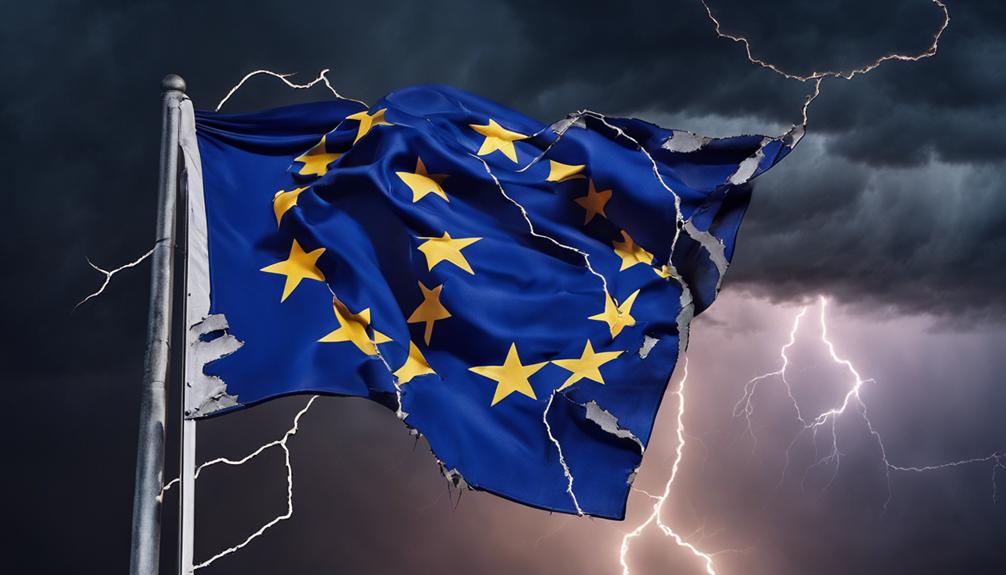
You're facing a European Union that's at a critical juncture, where the collective dreams of its post-war founders are increasingly threatened by rising nationalism, economic woes, and institutional weaknesses that are eroding its legitimacy. Disillusionment with the EU is growing, fueled by economic stagnation, migration crises, and a perceived disconnect between citizens and EU leaders. As you navigate this complex landscape, you'll find that the EU's future hangs in the balance, with possibilities ranging from further integration to dissolution. Will you uncover a path forward that strengthens the EU's institutions or paves the way for a looser confederation of nations?
EU's Post-War Dream Fading Fast
As you gaze out at the European Union's current landscape, it's hard not to feel a sense of disillusionment wash over you, as the post-war dream of a united, peaceful, and prosperous Europe seems to be rapidly losing its luster. The EU, once hailed as a beacon of hope and cooperation, now faces unprecedented challenges that threaten its very existence. You can't help but wonder if the EU's founding ideals of unity, solidarity, and collective progress are still relevant in today's complex, fragmented world.
As you look around, you see a continent torn apart by economic disparities, migration crises, and rising inequality. The EU's inability to effectively address these issues has led to widespread disillusionment among its citizens. You feel a growing sense of detachment, as if the EU's initial promise of a united Europe has given way to a harsh reality of bureaucratic red tape, inefficient decision-making, and a lack of accountability. The EU's slow response to pressing issues has created a power vacuum, allowing national interests to take precedence over collective goals. You can't help but ask: what happened to the EU's founding spirit of cooperation and collective progress? Can the EU rediscover its lost momentum, or is it destined to become a relic of the past?
Rise of Nationalism and Euroscepticism
You're witnessing a resurgence of nationalist sentiment across Europe, as EU citizens increasingly question the union's ability to address their concerns and fears, fueling a growing sense of Euroscepticism. This shift in public opinion is evident in the rise of nationalist parties and anti-EU movements, which are gaining popularity across the continent. You're seeing it in the UK, where Brexit has become a reality, and in countries like France, Germany, and Italy, where nationalist parties are making significant gains in elections.
As you look around, you'll notice that many Europeans are feeling disillusioned with the EU's handling of issues like immigration, security, and economic stagnation. They're questioning the benefits of EU membership and whether it's truly serving their national interests. This sentiment is further fueled by the perception that the EU is out of touch with the needs and concerns of ordinary citizens.
You're not alone in feeling that the EU's bureaucratic machinery is slow to respond to the changing needs of its citizens. Many Europeans are seeking a stronger sense of national identity and sovereignty, which they believe is being eroded by the EU's centralized power. As you navigate this complex landscape, it's clear that the rise of nationalism and Euroscepticism poses significant challenges to the EU's future.
Economic Woes and Inequality
Economic stagnation and rising inequality are fueling widespread disillusionment with the EU, particularly among marginalized communities who feel they're shouldering the heaviest burden of austerity measures. You're not alone if you're feeling the pinch of stagnant wages, reduced social services, and a growing sense of economic insecurity. The EU's failure to address these issues has led to a deepening sense of disillusionment, especially among young people, women, and minority groups.
You've probably noticed that the benefits of economic growth haven't trickled down to you and your community. Instead, the wealthy elite seem to be getting richer, while the rest are left struggling to make ends meet. This growing wealth gap is a ticking time bomb, threatening the very fabric of our societies. The EU's inability to address these issues has led to a crisis of trust, with many wondering if the EU is truly working for all its citizens.
As you struggle to make ends meet, you're not alone in feeling that the EU's economic policies have failed you. The rise of populist movements and anti-EU sentiment is, in part, a response to the EU's failure to address economic inequality. It's time for the EU to take concrete steps to address these issues, or risk further disillusionment and fragmentation. The future of the EU depends on its ability to create a more equitable society, where everyone has access to the same opportunities and resources.
Migration Crisis and Border Control
The EU's porous borders and inconsistent asylum policies have created a perfect storm, leaving you to wonder how the bloc can effectively manage the influx of migrants and refugees while maintaining internal security. You're not alone in this concern; many Europeans are questioning the EU's ability to safeguard its borders and guarantee the safety of its citizens. The recent surge in migrant arrivals has put a significant strain on the bloc's resources, leading to tensions between member states and sparking debates about the distribution of asylum seekers.
As you navigate the complexities of this crisis, you're likely to encounter conflicting views on how to address it. Some argue that stricter border controls are necessary to prevent illegal immigration, while others believe that a more compassionate approach is needed to provide humanitarian assistance to those fleeing war and persecution. You might be wondering how the EU can balance these competing demands and find a solution that works for all member states.
The EU's failure to develop a unified asylum policy has led to a patchwork of national approaches, creating confusion and inconsistencies. You're right to expect more from the EU; a more coordinated response is needed to address the root causes of migration, strengthen external borders, and provide a humane response to those seeking refuge. As the EU moves forward, you'll be watching closely to see if it can rise to the challenge and find a solution that safeguards the safety and security of all Europeans.
Brexit Fallout and UK Relations
As the Brexit dust settles, it's clear that the UK's departure has left a power vacuum that's forcing the EU to reexamine its relationships and alliances. You're likely wondering what this means for the future of the EU and its relationships with the UK. The truth is, Brexit has created a ripple effect, causing the EU to reevaluate its priorities and strategies.
You see, the UK's departure has left a significant gap in the EU's decision-making process, and other member states are now scrambling to fill the void. This has led to a shift in power dynamics, with countries like France and Germany taking on more prominent roles. As you navigate this new landscape, you'll notice that the EU is working to redefine its relationships with the UK and other non-member states.
One thing is certain: the EU can't afford to let its relationships with the UK deteriorate. You're probably aware that the UK is still one of the EU's largest trading partners, and maintaining a strong relationship is essential for economic stability. As the EU navigates this new reality, you can expect to see a renewed focus on cooperation and diplomacy. The EU will need to find ways to work with the UK while also protecting its own interests – a delicate balancing act that will require careful diplomacy and strategic thinking.
Enlargement Fatigue and Credibility
You're likely wondering how the EU's expansion strategy will fare in the post-Brexit era, and whether the bloc's credibility will take a hit. As you consider this, you might recall the EU's previous expansions, which were often met with enthusiasm and optimism. However, the current atmosphere is different. The EU's recent enlargements, particularly the accession of Bulgaria and Romania in 2007, were marked by controversy and criticism. This has led to a sense of "enlargement fatigue" among EU citizens and leaders alike.
You might be thinking that this fatigue stems from the EU's seemingly never-ending expansion, which has raised concerns about the bloc's ability to absorb new members. The EU's credibility is also at stake, as some member states have expressed doubts about the bloc's capacity to integrate new countries. The Western Balkans, for instance, are still waiting in the wings, and their accession process has been slow and arduous. The EU's inability to finalize these accessions has led to frustration and disillusionment among the aspiring member states.
As you ponder the EU's expansion strategy, you're probably wondering whether the bloc can regain its momentum and credibility. The answer lies in the EU's ability to reform and adapt to the changing geopolitical landscape. By doing so, the EU can revitalize its expansion strategy and restore faith in its ability to integrate new members. The EU's credibility depends on it, and its future hinges on its ability to rise to the challenge.
EU's Global Role in Question
Your faith in the EU's global influence is likely wavering, given the bloc's recent struggles to assert its authority on the world stage. You're not alone in questioning the EU's ability to lead globally. The EU's inability to address pressing issues, such as the migration crisis, has led to a perception of weakness. Additionally, the rise of nationalist movements and populist leaders has further eroded the EU's credibility.
You might wonder, what happened to the EU's ambitious foreign policy goals? The reality is that the EU's global role is being challenged from within and outside its borders. The UK's departure from the EU has weakened the bloc's economic and military prowess. Moreover, the EU's inability to project power and assert its interests in its own backyard, such as in Ukraine, has raised doubts about its ability to lead.
As you ponder the EU's future, you can't help but ask, what does the EU stand for? Is it still a beacon of democracy, human rights, and the rule of law? Or has it become a mere spectator in global affairs? The EU's global role is in question, and it's up to its leaders to redefine its purpose and relevance in a rapidly changing world. You, as a citizen, have a stake in this debate. The EU's future depends on its ability to adapt, reform, and reclaim its position as a global leader.
Institutional Reforms and Governance
Reforming the EU's institutional framework and governance structures is crucial to restoring its global credibility, and you can't help but wonder if the bloc's leaders are ready to tackle the necessary reforms to revitalize its influence. As you ponder the future of the EU, you realize that it's not just about tweaking existing policies, but rather about transforming the very fabric of the institution. The EU's governance structure, which was once hailed as a beacon of cooperation and unity, now seems outdated and inefficient.
To tackle this, the EU needs to streamline its decision-making processes, enhance transparency, and strengthen accountability. This can be achieved by implementing reforms that promote greater coordination between member states, increase the role of the European Parliament, and enhance the Commission's executive powers.
| Reform Area | Current Challenges | Proposed Solutions |
|---|---|---|
| Decision-Making | Bureaucratic red tape | Streamline processes, reduce veto powers |
| Transparency | Lack of accountability | Increase parliamentary oversight, enhance transparency |
| Coordination | Inefficient communication | Establish clear communication channels, foster cooperation |
| Accountability | Weak enforcement | Strengthen Commission's executive powers, enhance judicial oversight |
| Representation | Limited parliamentary role | Enhance European Parliament's role in decision-making |
Democratic Deficit and Legitimacy
One glaring issue that has plagued the EU since its inception is the democratic deficit, which has led to a growing sense of distrust among citizens, eroding the bloc's legitimacy. You're not alone if you've ever felt disconnected from the EU's decision-making process or wondered who's really in charge. This sense of disconnection stems from the EU's complex system, where power is divided among various institutions, making it difficult to pinpoint accountability. As a result, many citizens feel their voices aren't being heard, and their concerns are being ignored.
This democratic deficit has serious consequences. It fuels feelings of disillusionment and apathy, causing many to question the EU's legitimacy. You might be thinking, "What's the point of having a say if my vote doesn't count?" or "Why bother engaging with the EU when it seems so detached from my daily life?" These concerns are valid, and the EU must address them to regain the trust of its citizens.
To bridge this gap, the EU needs to become more transparent, accessible, and accountable. You deserve to know how decisions are made and who's responsible for them. By doing so, the EU can rebuild trust and foster a sense of belonging among its citizens. It's time for the EU to reconnect with the people it serves, ensuring that your voice is heard and valued.
Populist Surge and EU Elections
As you navigate the complexities of the European Union, you can't help but notice the significant shift in the political landscape. Since 2014, a staggering 20% of MEPs have been affiliated with populist or far-right parties, reflecting a seismic shift in the European political landscape that's left many wondering if the EU is heading towards a populist takeover.
This surge in populist support has been fueled by growing disillusionment with the EU’s handling of issues like immigration, economic inequality, and national sovereignty. The rise of populist parties has led to a sense of unease among traditional centrist parties, who fear that the EU’s values of unity and cooperation are under threat. As populist parties gain traction, traditional centrist parties have struggled to communicate their messages effectively, leading to a polarization of the political landscape. This divide has made it increasingly difficult for voters to identify effective news sources for politics, as misinformation can easily spread within echo chambers. In response, centrist parties must not only reinforce their core values but also ensure that they engage actively with the electorate to restore trust in their narratives.
Here's a breakdown of the populist presence in the European Parliament:
| Country | Populist MEPs |
|---|---|
| Italy | 29 |
| France | 22 |
| Germany | 19 |
| UK | 18 |
As you examine the table, you'll notice that populist parties have made significant gains in several key EU member states. This trend is likely to continue, as populist leaders capitalize on public discontent and sense of disaffection with the EU's perceived elitism.
The implications of this populist surge are far-reaching, and it's essential that you, as a concerned citizen, stay informed about the changing dynamics of EU politics. Will the EU be able to adapt to these shifting tides, or will the populist wave continue to reshape the European political landscape?
Scenarios for EU's Future Trajectory
You're left wondering what the EU's future trajectory might look like, given the significant inroads populist parties have made in the European Parliament. As you ponder the possibilities, three scenarios emerge as potential paths forward for the European Union.
In the first scenario, the EU continues down a path of gradual integration, with member states working together to address common challenges like climate change, economic inequality, and migration. This trajectory would see the EU strengthen its institutions, enhance its role in global governance, and deepen its relationships with neighboring countries. In this scenario, the EU becomes an even more prominent player on the world stage, leveraging its collective strength to promote peace, stability, and prosperity.
In the second scenario, the EU takes a more decentralized approach, with member states reclaiming powers from Brussels and forging their own paths. This trajectory would see the EU become a looser confederation of nations, with each country pursuing its own interests and priorities. In this scenario, the EU's influence wanes, and its ability to address common challenges is diminished.
In the third scenario, the EU faces dissolution, as member states choose to go it alone and the European project unravels. This trajectory would see the EU's institutions weakened, its economy fragmented, and its people divided. In this scenario, the EU's future looks bleak, and the consequences of its demise are far-reaching and unpredictable.
Frequently Asked Questions
Can the EU Maintain a Unified Stance on Global Issues Without the Uk?
You're wondering if the EU can maintain a unified stance on global issues without the UK. Honestly, it's tough, but not impossible. You see, the EU's strength lies in its collective power, and with the UK's departure, that power takes a hit. However, if you look at the EU's past, you'll see that it's adapted to challenges before. The remaining member states can still work together to present a united front on global issues, but it'll require more effort and coordination.
Will the Eu's Migration Policy Prioritize Border Control or Human Rights?
You're wondering if the EU's migration policy will prioritize border control or human rights. As you consider this question, think about the EU's commitment to upholding human dignity and protecting vulnerable populations. Will the EU prioritize securing its borders, or will it prioritize ensuring the safety and well-being of migrants and asylum seekers? The answer will have far-reaching implications for the EU's values and identity.
Are EU Member States' Economic Interests More Important Than Collective Unity?
You're wondering if EU member states prioritize their economic interests over collective unity. Honestly, it's a tough call. On one hand, economic growth is vital for a country's survival. On the other hand, unity is what makes the EU strong. You might think that economic interests would win out, but many member states are willing to make sacrifices for the greater good. It's a delicate balance, and you'll see that both aspects are essential for the EU's success.
Can the EU Reform Its Institutions to Regain Citizens' Trust and Confidence?
You wonder if the EU can reform its institutions to regain citizens' trust and confidence. The answer lies in transparency and accountability. You deserve to know how decisions are made and who's making them. The EU must simplify its bureaucracy, making it easier for you to understand and engage with the institution. By doing so, you'll feel more connected to the EU and its goals, ultimately rebuilding trust and confidence.
Will the Eu's Expansion Plans Consider Turkey's Membership Bid?
As you ponder the EU's expansion plans, you're likely wondering if Turkey's membership bid will get a green light. It's a sensitive topic, like a delicate dance between two partners. Will the EU open its doors to Turkey, embracing its unique cultural flair, or will it keep the door ajar, hesitant to fully commit? You might be thinking, "What's the holdup?" The answer lies in the EU's careful balancing act between unity and diversity.
