

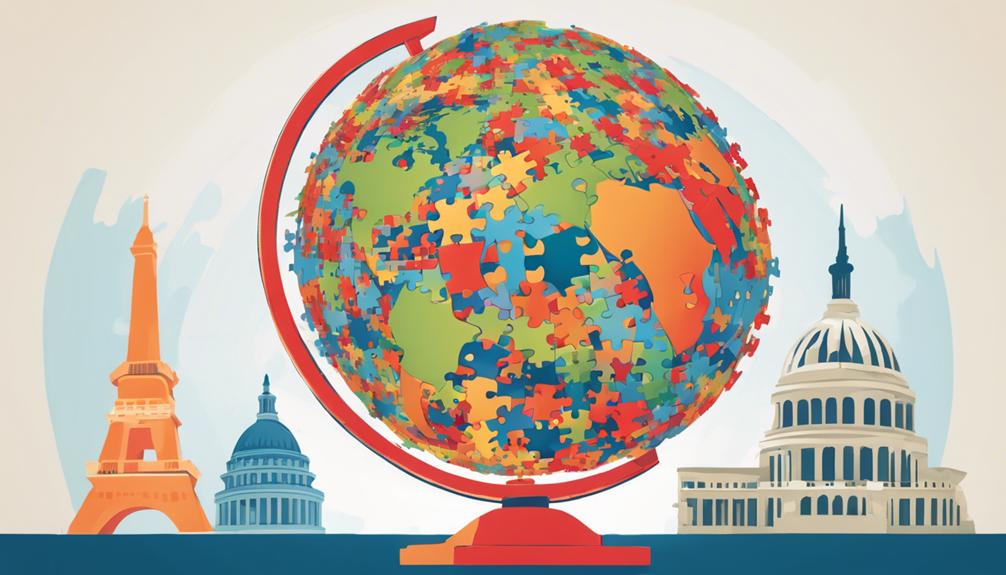
You're about to commence on a fascinating journey to explore the diverse world of government systems! You'll encounter presidential systems, where a directly elected president holds significant power, and parliamentary democracies, where the legislative branch takes center stage. Then, there are authoritarian regimes, where control is maintained through coercion, and hybrid systems, which blend different structures. As you navigate these varied systems, you'll uncover the intricacies of party politics, electoral systems, and separation of powers. Stay curious, and you'll discover even more about how governments shape our world and the complexities that come with them.
Presidential Systems of Government
In a presidential system of government, you're likely to find a president who serves as both the head of state and the head of government, combining ceremonial duties with actual policymaking power. This dual role gives the president significant influence over the country's direction. You'll often find that the president is directly elected by the people, which can create a strong sense of accountability to the citizens.
As the head of government, the president is responsible for appointing key officials, including cabinet members and judges. You might be surprised to learn that the president also plays an important role in shaping foreign policy, as they often serve as the chief diplomat for the nation. This can lead to a more personalized approach to international relations, as the president's personal relationships with other world leaders can greatly impact diplomatic efforts.
One of the key benefits of a presidential system is that it provides stability and continuity, as the president serves a fixed term. This can be particularly important during times of crisis, as the president can provide a sense of calm and direction. As you explore presidential systems of government, you'll discover that they can be found in countries around the world, each with their unique characteristics and strengths.
Parliamentary Democracy in Action
As you explore the inner workings of parliamentary democracy, you'll notice that power is concentrated in the legislative branch, where the prime minister and cabinet members are drawn from the majority party or coalition. This system creates a unique dynamic, where the prime minister, as the head of government, is also a member of the legislature. This fusion of powers allows for efficient decision-making and a high degree of accountability.
In a parliamentary democracy, the prime minister and cabinet are responsible for implementing policies and making decisions, while the legislature provides oversight and scrutiny. This checks-and-balances system guarantees that power is distributed evenly, preventing any one branch from dominating the others.
Here's a breakdown of key characteristics in parliamentary democracies:
| Features | Description |
|---|---|
| Head of Government | Prime Minister, drawn from the majority party or coalition |
| Legislative Power | Concentrated in the legislative branch |
| Accountability | Prime Minister and cabinet accountable to the legislature |
As you dig deeper into parliamentary democracy, you'll discover that this system promotes stability, cooperation, and representation. By concentrating power in the legislative branch, parliamentary democracies foster a sense of belonging among citizens, who feel their voices are heard through their elected representatives.
Authoritarian Regimes and Control
As you explore authoritarian regimes, you'll find that they often rely on a coercive state apparatus to maintain power. This can involve suppressing political opposition, sometimes through violent means, and limiting civil liberties to stifle dissent. By examining these tactics, you'll gain a deeper understanding of how authoritarian governments exert control over their citizens.
Coercive State Apparatus
You live under the watchful eye of the coercive state apparatus, where authoritarian regimes wield power through a network of surveillance, propaganda, and brutal force. Every move you make is monitored, every word you say is scrutinized, and every thought you think is suspected. The regime's grip on your life is suffocating, leaving you feeling trapped and powerless.
The coercive state apparatus is designed to maintain control and crush dissent. It's a system of oppression, where the regime's interests are prioritized over individual freedom and human rights. Here are some key features of this apparatus:
- Surveillance state: Your every move is tracked, and your personal data is collected and analyzed to identify potential threats to the regime.
- Propaganda machine: The regime controls the narrative, spreading disinformation and manipulating public opinion to maintain its grip on power.
- Repression of dissent: Any form of opposition is crushed, and those who dare to speak out are silenced, intimidated, or punished.
- Cult of personality: The regime's leader is idolized, and any criticism is seen as a threat to national security.
In this environment, your sense of belonging is tied to your loyalty to the regime. Any deviation from the norm is seen as a threat, and you're forced to conform to survive.
Suppressing Political Opposition
The regime's stranglehold on power relies heavily on suppressing political opposition, where even whispers of dissent are swiftly silenced, and any potential challengers are co-opted or crushed. You're likely to see a pattern of manipulation, where the regime creates a sense of fear and uncertainty among the population. This climate of fear makes it difficult for opposition groups to organize and gain traction. You might notice that the regime tightly controls the media, suppressing any voices that dare to challenge its authority. Even online platforms are closely monitored, and any dissenting voices are quickly silenced. The regime's grip on power is so strong that it can co-opt potential challengers, either by bribing them or by using propaganda to discredit them. As a result, you'll rarely see a strong, organized opposition in an authoritarian regime. The regime's ability to suppress political opposition is a key factor in its ability to maintain power.
Limited Civil Liberties
Civil liberties, including freedom of speech, assembly, and association, are severely curtailed in authoritarian regimes, where the government tightly controls what you can say, do, and believe. You're constantly being monitored, and any dissenting voices are swiftly silenced. The government dictates what information you can access, and any form of protest or criticism is met with brutal force.
In such regimes, you're forced to conform to the government's ideology, and any deviation is seen as a threat. The state exercises total control over your life, suppressing any form of individuality or creativity. You're reduced to mere automatons, devoid of autonomy or free will.
Here are some ways authoritarian regimes curb civil liberties:
- Censorship: The government controls the flow of information, suppressing any criticism or dissenting voices.
- Surveillance: You're constantly monitored, and your every move is tracked and recorded.
- Restrictions on assembly: Gatherings and protests are heavily restricted, and any form of collective action is discouraged.
- Propaganda: The government disseminates its own ideology, suppressing alternative viewpoints and independent thought.
In such an environment, you're forced to surrender your autonomy and individuality, conforming to the government's rigid expectations.
Hybrid Systems and Power Struggles
In hybrid systems, power struggles often emerge as different branches or levels of government jockey for control and influence. You might be wondering why this happens. Well, it's because hybrid systems combine elements of different government structures, like presidential and parliamentary systems. This blend can create tension between the executive, legislative, and judicial branches, as each tries to assert its authority.
As you explore hybrid systems, you'll notice that power struggles can manifest in various ways. For instance, the president or prime minister might clash with the legislature over policy decisions or budget allocations. Alternatively, the judiciary might challenge the executive's actions, citing constitutional violations. These conflicts can lead to gridlock, slowing down decision-making and policy implementation.
You might be curious about the implications of these power struggles. In some cases, they can lead to instability, undermining the government's effectiveness. However, they can also foster accountability and checks on power, preventing any one branch from dominating the others. As you investigate further into hybrid systems, consider how these power dynamics shape the governance and policy outcomes in different countries. By understanding these struggles, you'll gain insights into the intricacies of hybrid systems and their impact on citizens' lives.
The Role of Political Parties
As you explore the role of political parties in government systems, you'll discover that their ideology and platform shape their policy decisions and interactions with citizens. You'll also examine how the party system influences governance, including the distribution of power and representation. By considering these factors, you'll gain a deeper understanding of how political parties impact the functioning of governments.
Party Ideology and Platform
When you examine the inner workings of a government, you'll often find that political parties play an important role in shaping the country's policies and laws. A party's ideology and platform are vital in understanding their stance on various issues and how they intend to address them. Essentially, a party's ideology represents its core beliefs and values, while its platform outlines specific policy proposals.
Here are four key aspects of party ideology and platform:
- Core values: A party's ideology is rooted in its fundamental values, such as equality, freedom, or justice. These values guide its policy decisions and shape its platform.
- Policy proposals: A party's platform outlines specific policy proposals, such as taxation, education, or healthcare reforms. These proposals reflect the party's ideology and values.
- Electoral appeal: A party's ideology and platform can greatly influence voter decisions. Voters often identify with parties that align with their own values and beliefs.
- Government policy: Once in power, a party's ideology and platform shape the country's laws and policies, ultimately affecting the lives of citizens.
Party System and Governance
You'll often find that the party system plays a significant role in governance, as it directly influences the way power is distributed and exercised within a government. The party system shapes the dynamics of governance, determining who holds power, how decisions are made, and what policies are implemented. In a multi-party system, you'll typically see a more diverse representation of interests, leading to a more inclusive and representative government. On the other hand, a dominant-party system can lead to a concentration of power, potentially limiting opportunities for opposition and dissent.
As you explore different government systems, you'll notice that the party system can also impact the stability and effectiveness of governance. In some cases, a strong party system can provide a sense of continuity and stability, while in others, it can lead to gridlock and inefficiency. By understanding the role of political parties in governance, you'll gain valuable insights into the inner workings of different government systems and how they shape the lives of citizens.
Electoral Systems and Voter Behavior
Electoral systems greatly influence voter behavior, shaping the way citizens participate in the democratic process. You, as a voter, are likely to be affected by the electoral system in place in your country. The way votes are cast, counted, and translated into seats in the legislature can have a profound impact on the outcome of an election. This, in turn, affects the way political parties campaign, the issues they focus on, and the policies they propose.
You might wonder, what are the key factors that influence voter behavior in different electoral systems? Here are some key takeaways:
- Proportional Representation: In this system, parties are awarded seats based on the proportion of votes they receive. This can lead to a more representative legislature, but may also result in coalition governments.
- First-Past-The-Post: In this system, the candidate with the most votes wins the seat. This can lead to a two-party dominance, but may also result in a lack of representation for smaller parties.
- Mixed-Member Systems: This system combines elements of proportional representation and first-past-the-post systems. It can provide a balance between local representation and proportional representation.
- Voter Thresholds: In some systems, parties must reach a minimum threshold of votes to enter the legislature. This can affect the viability of smaller parties and the overall fragmentation of the political landscape.
Understanding electoral systems is essential for you to make informed decisions at the ballot box. By recognizing the nuances of different systems, you can better navigate the democratic process and make your voice heard.
Separation of Powers in Democracies
As you explore the concept of separation of powers in democracies, you'll discover how it's designed to distribute authority among three branches of government. You'll learn how the legislature, led by elected representatives, creates laws, while the executive branch, headed by a president or prime minister, enforces them. Meanwhile, the judiciary, comprising courts and judges, guarantees that both branches operate within the boundaries of the constitution, a vital check on power that maintains the system's balance.
Powers of the Legislature
In democracies that adhere to the principle of separation of powers, the legislature, comprising elected representatives, exercises significant authority over lawmaking, budgeting, and oversight of the executive branch. You, as a citizen, have a stake in the legislative process, and it's essential to understand the powers entrusted to your representatives.
The legislature's powers can be broken down into four key areas:
- Lawmaking: The legislature has the authority to create, amend, and repeal laws that govern the country.
- Budgeting: As the appropriations authority, the legislature decides how public funds are allocated and spent.
- Oversight: The legislature has the power to conduct investigations, hold hearings, and exercise supervision over the executive branch to uphold accountability.
- Representation: As your elected representatives, legislators are responsible for listening to your concerns, representing your interests, and making decisions that benefit the community.
Executive Branch Limitations
You need to be aware that the executive branch, headed by the president or prime minister, is not all-powerful, and its authority is deliberately limited by the separation of powers doctrine to prevent abuses and guarantee responsibility. This means that the executive branch can't unilaterally make laws or interpret them as it sees fit. Instead, it must work within the framework established by the legislative and judicial branches.
You'll notice that the executive branch's powers are often checked by the legislature, which can reject or modify its proposals. Additionally, the judiciary can review and strike down executive actions deemed unconstitutional. This system of checks and balances ensures that no one branch dominates the others, protecting individual rights and preventing the concentration of power.
As you explore different government systems, you'll see that these limitations on the executive branch vary in scope and implementation. However, the underlying principle remains the same: to prevent abuses of power and make sure that the government remains accountable to its citizens. By understanding these limitations, you'll gain a deeper appreciation for the intricacies of democratic governance and the importance of accountability in government.
Judicial Review Process
The judiciary's role in reviewing executive and legislative actions is a cornerstone of democratic governance, and it's your task to understand how this process, known as judicial review, reinforces the separation of powers. This vital check on power ensures that no single branch dominates the others, preventing authoritarianism and protecting individual rights.
As you explore the judicial review process, you'll discover it's not just about resolving disputes, but also about maintaining the delicate balance of power. Here are some key aspects to take into account:
- Legislative scrutiny: Courts review laws to guarantee they align with the constitution, preventing overreach by the legislative branch.
- Executive accountability: Judicial review holds the executive branch accountable for their actions, preventing abuse of power.
- Individual protection: The judiciary safeguards individual rights, ensuring they're not infringed upon by government actions.
- Institutional balance: Judicial review maintains the balance between the three branches, preventing any one branch from dominating the others.
Checks and Balances in Action
As the legislative, executive, and judicial branches of government interact, their powers intersect, and the system of checks and balances springs into action. You're probably wondering how this system works in practice. Let's delve deeper!
The system of checks and balances guarantees that no one branch becomes too powerful. You see, each branch has certain powers that can limit the actions of the other branches. For instance, Congress can check the President's power by overriding a veto with a two-thirds majority vote. Similarly, the President can veto laws passed by Congress, and the Supreme Court can declare laws passed by Congress or actions taken by the President as unconstitutional.
Here's a breakdown of how the system of checks and balances works:
| Branch | Check on Other Branches |
|---|---|
| Legislative | Can override presidential vetoes, approve presidential appointments |
| Executive | Can veto laws passed by Congress, appoint judges and officials |
| Judicial | Can declare laws and actions as unconstitutional, try federal cases |
As you can see, each branch has unique powers that can limit the actions of the other branches. This delicate balance of power ensures that no one branch dominates the others, protecting individual rights and promoting accountability. By understanding how the system of checks and balances operates, you'll gain a deeper appreciation for the intricate design of your government.
The Impact of Federalism and Decentralization
Now that you've explored how the system of checks and balances prevents any one branch of government from becoming too powerful, it's time to examine how federalism and decentralization shape the relationship between the national government and individual states. As you dive into the world of comparative politics, you'll discover that federalism is a system where power is divided between a central authority and smaller, regional governments. Decentralization takes this concept further, granting more autonomy to local governments. This division of power has a profound impact on governance, as it influences how policies are made and implemented.
Here are four key aspects of federalism and decentralization to ponder:
- Power distribution: Federalism ensures that power is distributed between the national government and individual states, preventing any one entity from becoming too dominant.
- Regional autonomy: Decentralization allows regional governments to make decisions tailored to their unique needs and circumstances.
- Policy variation: With decentralized power, different regions can experiment with distinct policies, fostering innovation and adaptation to local contexts.
- National cohesion: Federalism promotes national unity by providing a framework for cooperation and coordination between regional governments.
Economic Systems and Government Policy
You'll explore various economic systems, from command economies to market-based systems, each shaped by government policies that influence production, distribution, and consumption of goods and services. As you investigate the world of economic systems, you'll discover how governments play a crucial role in shaping the economy. Command economies, like those seen in socialist or communist countries, rely heavily on government control and planning. In contrast, market-based economies, like those in capitalist countries, rely on private enterprise and individual initiative.
Government policies, such as taxation, regulation, and subsidies, can have a profound impact on the economy. For instance, fiscal policies can stimulate economic growth or curb inflation. Monetary policies, set by central banks, can influence interest rates and money supply. You'll also find that governments use trade policies to promote exports, protect domestic industries, or restrict imports.
As you explore different economic systems, you'll realize that governments must strike a balance between promoting economic growth and ensuring social welfare. You'll see how governments use policies to address issues like poverty, inequality, and environmental degradation. By understanding the interplay between economic systems and government policies, you'll gain insight into the complexities of governance and the challenges of creating a prosperous and equitable society.
Human Rights and Government Accountability
In a democratic system, your right to participate in the political process is closely tied to the government's accountability, ensuring that your voice is heard and your human rights are protected. When you exercise your right to vote, attend town hall meetings, or engage in peaceful protests, you're holding your government accountable for upholding your fundamental rights. This accountability is essential in preventing human rights abuses and ensuring that your government serves the people, not just the interests of a select few.
Governments that prioritize accountability are more likely to:
- Investigate and prosecute human rights abuses, ensuring that those responsible are held accountable for their actions.
- Implement policies that promote equality and justice, reducing discrimination and promoting equal opportunities for all citizens.
- Provide transparency in governance, making it easier for citizens to access information and participate in the decision-making process.
- Protect freedom of expression and assembly, allowing citizens to voice their opinions and hold their government accountable without fear of reprisal.
Political Culture and Socialization
As you exercise your right to participate in the political process, you're not only holding your government accountable but also shaping your political culture, which is deeply rooted in the socialization process that influences your beliefs, values, and attitudes towards politics. This socialization process begins at a young age, as you learn about politics and governance from family, friends, schools, and the media. These influences shape your political identity and inform your opinions on key issues.
As you grow and engage with your community, you're exposed to different perspectives and experiences that further refine your political culture. You may find yourself aligning with certain ideologies or parties, or perhaps you'll develop your own unique perspective. Either way, your political culture is constantly evolving, reflecting the complex interplay between your individual experiences and the broader societal context.
Your political culture, in turn, affects how you interact with the government and other citizens. It influences how you vote, participate in civic activities, and engage in public discourse. By recognizing the role of socialization in shaping your political culture, you can become a more informed and active participant in the democratic process. You'll be better equipped to navigate the complexities of governance, engage in constructive dialogue, and work towards creating a more inclusive and just society.
Globalization and Political Change
Globalization's profound impact on the world economy has triggered a wave of political changes, forcing governments to reevaluate their policies and adapt to new realities. As you navigate this complex landscape, you're likely wondering how globalization is reshaping the political landscape. The truth is, globalization has created new challenges and opportunities for governments worldwide. On one hand, it has opened up new markets and opportunities for economic growth. On the other hand, it has also created new social and economic inequalities, posing significant challenges to governments.
As you consider the implications of globalization on political systems, keep the following key points in mind:
- Shift to neoliberal policies: Globalization has led to a shift towards neoliberal policies, which prioritize free trade, deregulation, and privatization.
- Rise of international institutions: Globalization has given rise to international institutions like the World Trade Organization (WTO), the International Monetary Fund (IMF), and the World Bank, which play an important role in shaping global economic policies.
- Increased migration and cultural exchange: Globalization has facilitated increased migration and cultural exchange, leading to more diverse societies and new social and political challenges.
- Growing income inequality: Globalization has exacerbated income inequality, as those who are already wealthy tend to benefit more from globalization than those who are less well-off.
As you explore the complex relationships between globalization and political change, remember that these factors are interconnected and influenced by a multitude of factors. The rapid flow of information and ideas across borders can either empower grassroots movements or reinforce existing power structures, depending on local contexts. Furthermore, the political influence of dynasties can significantly shape how globalization is embraced or resisted, as established families often navigate the complexities of modern governance while attempting to maintain their historical legacies. Understanding these dynamics requires a nuanced examination of both global trends and local customs.
Frequently Asked Questions
What Is the Ideal Balance Between Government Power and Individual Freedom?
Imagine yourself in ancient Greece, sipping wine with Socrates, pondering the ideal balance between government power and individual freedom. You wonder, 'How much control is too much?' You crave autonomy, yet desire protection. You realize that finding this balance is like maneuvering a tightrope – too much government power, and you're trapped; too little, and you're vulnerable. You must find the sweet spot where your freedom flourishes, yet society remains stable.
Can a Hybrid System Be Both Stable and Democratic?
You're wondering if a hybrid system can strike the perfect balance between stability and democracy. You're not alone in this quest for the ideal governance model. In reality, a hybrid system can be both stable and democratic, as it combines the strengths of different systems. By blending, for instance, the efficiency of authoritarianism with the accountability of democracy, a hybrid system can create a stable environment that protects individual freedoms. It's a delicate balance, but it's achievable.
How Do Cultural Norms Influence Political Participation and Voter Turnout?
You're wondering how cultural norms influence political participation and voter turnout. Well, it turns out that cultural norms play a significant role in shaping your political behavior. For instance, if you're from a culture that values civic engagement, you're more likely to vote. On the other hand, if you're from a culture that's more individualistic, you might be less likely to participate in the political process. Your cultural norms can either encourage or discourage you from exercising your right to vote.
What Role Do Non-Governmental Organizations Play in Shaping Policy?
You're standing at the intersection of power and influence, where non-governmental organizations (NGOs) wield significant sway over policy. Like a master puppeteer, they pull the strings, shaping decisions that impact your life. NGOs, with their grassroots connections and expertise, amplify marginalized voices, mobilizing communities and informing policymakers. As you navigate this complex web, remember that NGOs are the unsung heroes, driving change and fostering a more just, equitable society.
Can Globalization Lead to a Decline in National Sovereignty?
You're probably wondering, can globalization really erode national sovereignty? The answer is, it's complicated. On one hand, globalization can lead to a loss of control over economic and cultural policies. On the other hand, it can also create opportunities for countries to collaborate and shape global policies. As you navigate this complex issue, remember that national sovereignty is not just about control, but also about cooperation and mutual benefit.
